
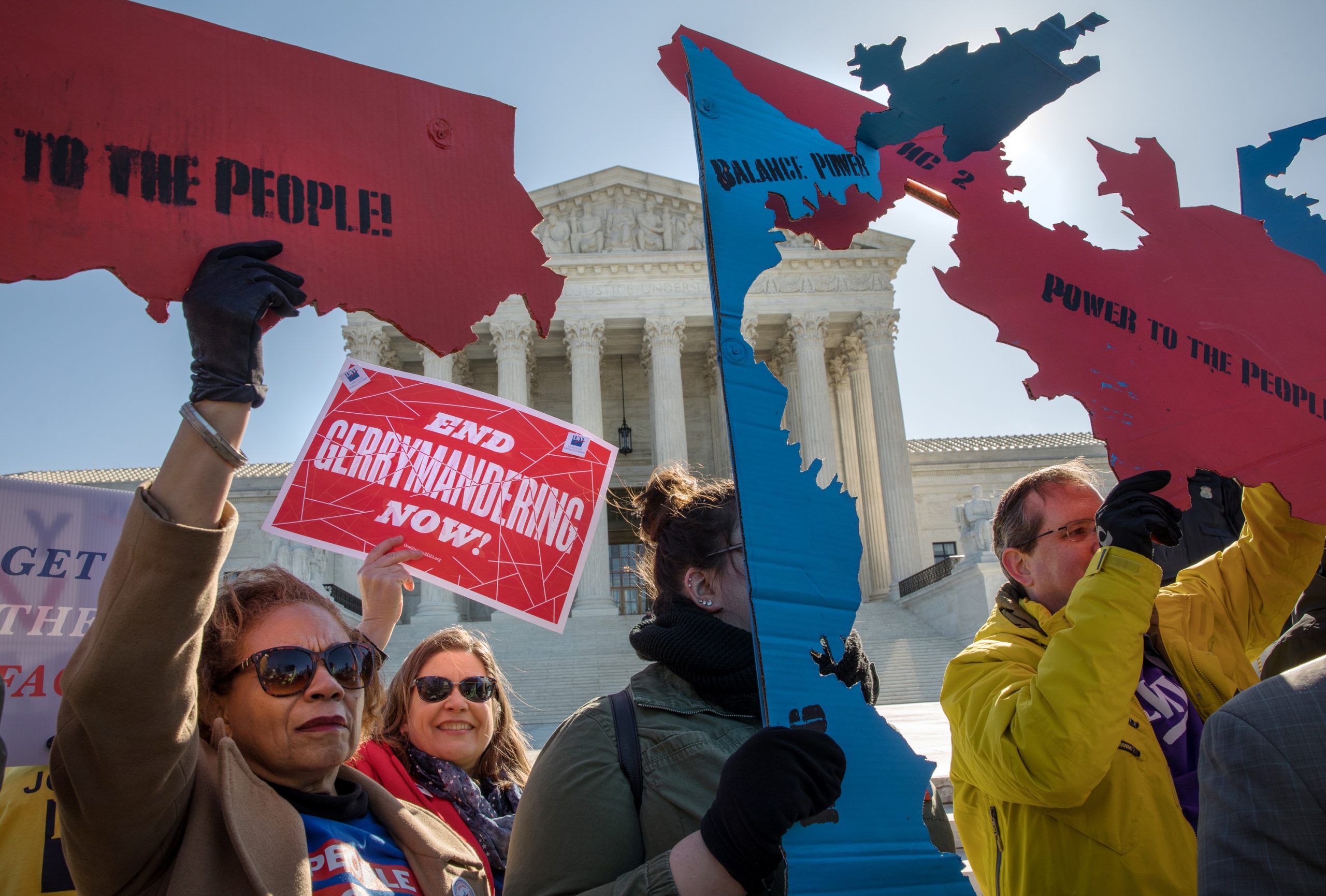
Supreme Court to Rule on Partisan Gerrymandering: A Nation Divided?
The Supreme Court is poised to deliver a potentially landmark ruling on partisan gerrymandering, a practice where electoral district boundaries are manipulated to favor one political party over another. This decision, stemming from cases in Texas and California, could dramatically reshape the political landscape and influence the fairness of elections across the United States.
Texas and California: Two Sides of the Gerrymandering Coin
The court’s involvement began with a challenge to Texas’s Republican-drawn redistricting map. A lower federal court initially struck down the map, citing evidence suggesting it was designed, at least in part, to dilute the voting power of minority groups. However, the Supreme Court’s conservative majority reinstated the Texas map, arguing that the evidence presented was insufficient to prove racial gerrymandering.
Simultaneously, the court is considering
Tangipa v. Newsom
, a case challenging California’s attempt to counteract the Texas gerrymander with its own Democratic-leaning map. While evidence of racial motivation is less prominent in the California case, the state’s Republican party argues that the map still constitutes an unfair partisan advantage.
What’s at Stake: The Future of Fair Representation
The core question before the Supreme Court is whether partisan gerrymandering is inherently unconstitutional. Critics argue that extreme gerrymandering undermines democracy by creating safe seats for incumbents, reducing electoral competition, and disenfranchising voters whose preferred candidates have little chance of winning. If the court rules in favor of the challengers in either the Texas or California case, it could establish stricter limits on partisan redistricting, potentially forcing states to adopt more neutral or independent redistricting processes.
Conversely, a ruling that effectively greenlights partisan gerrymandering could embolden both parties to draw even more aggressively partisan maps, further exacerbating political polarization and undermining public trust in the electoral system.
A Nation Watching
The Supreme Court’s decision on partisan gerrymandering will have far-reaching consequences for American democracy. It will determine the extent to which political parties can manipulate district lines to their advantage and shape the balance of power in Congress and state legislatures for years to come. As the nation awaits the ruling, the debate over fair representation and the integrity of the electoral process remains at the forefront of the political discourse. The decision will likely be one of the most impactful rulings on election law in recent history.
Based on materials: Vox



