
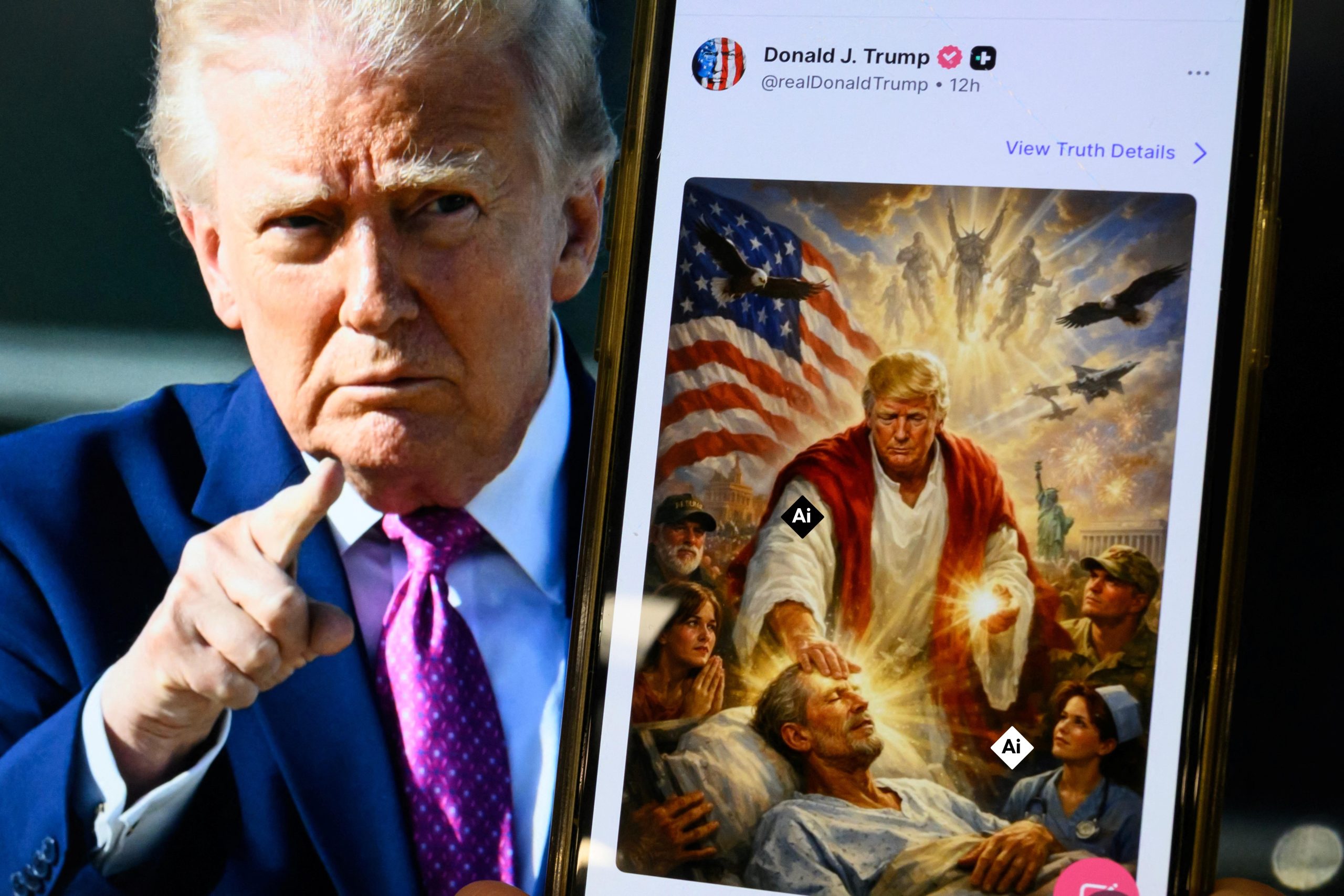
The intersection of artificial intelligence, faith, and American politics has taken a peculiar turn, with a recent AI-generated image of former President Donald Trump as Jesus Christ sparking a renewed discussion about eschatological figures in the political arena. The incident, originating on Trump’s Truth Social platform, has drawn sharp reactions from both supporters and critics, highlighting the potent role of religious symbolism in shaping political discourse.
AI Image Sparks Divine and Damned Reactions
The controversy began when an AI-generated image depicting Donald Trump with a Christ-like aura was posted on Truth Social. While Trump later attributed the image to a misunderstanding, suggesting he was intended to be portrayed as a doctor, the visual had already circulated widely and ignited a firestorm. For a segment of his Christian base, the image crossed a line, prompting some prominent far-right figures, including Marjorie Taylor Greene, Tucker Carlson, and Nick Fuentes, to question whether Trump himself might be embodying the figure of the Antichrist. This interpretation, however contentious, taps into deeply ingrained apocalyptic narratives that have influenced American political thought for generations.
A Recurring Theme: Armageddon in American Politics
The notion of Armageddon and the Second Coming of Christ has been a recurring undercurrent in American political thought since at least the late 19th century. As historian Matthew Sutton, author of “Chosen Land: How Christianity Made America and Americans Remade Christianity,” points out, these eschatological beliefs have often served as a guiding principle for certain political movements and ideologies. The current debate, fueled by advanced AI technology, serves as a modern manifestation of this long-standing phenomenon, demonstrating how ancient religious prophecies can be reinterpreted and amplified in the digital age. The ability of AI to rapidly generate and disseminate such potent imagery blurs the lines between reality and perception, making these symbolic discussions all the more impactful.
The Blurring Lines of Faith and Politics in the Digital Age
This incident underscores the complex and often fraught relationship between faith, politics, and technology in contemporary America. The use of AI to create religiously charged imagery, whether intentional or not, raises questions about the manipulation of symbols and the potential for religious fervor to be weaponized in political campaigns. As these technologies become more sophisticated and accessible, the challenges of discerning truth from fabrication, and the potential for deeply held beliefs to be exploited, will only intensify. The “Antichrist” debate, sparked by a single AI image, is a stark reminder of the enduring power of religious narratives and the evolving ways they are integrated into the fabric of American political discourse. The implications for future elections and the broader societal understanding of faith and politics remain a critical area to watch.
Based on materials: Vox



