
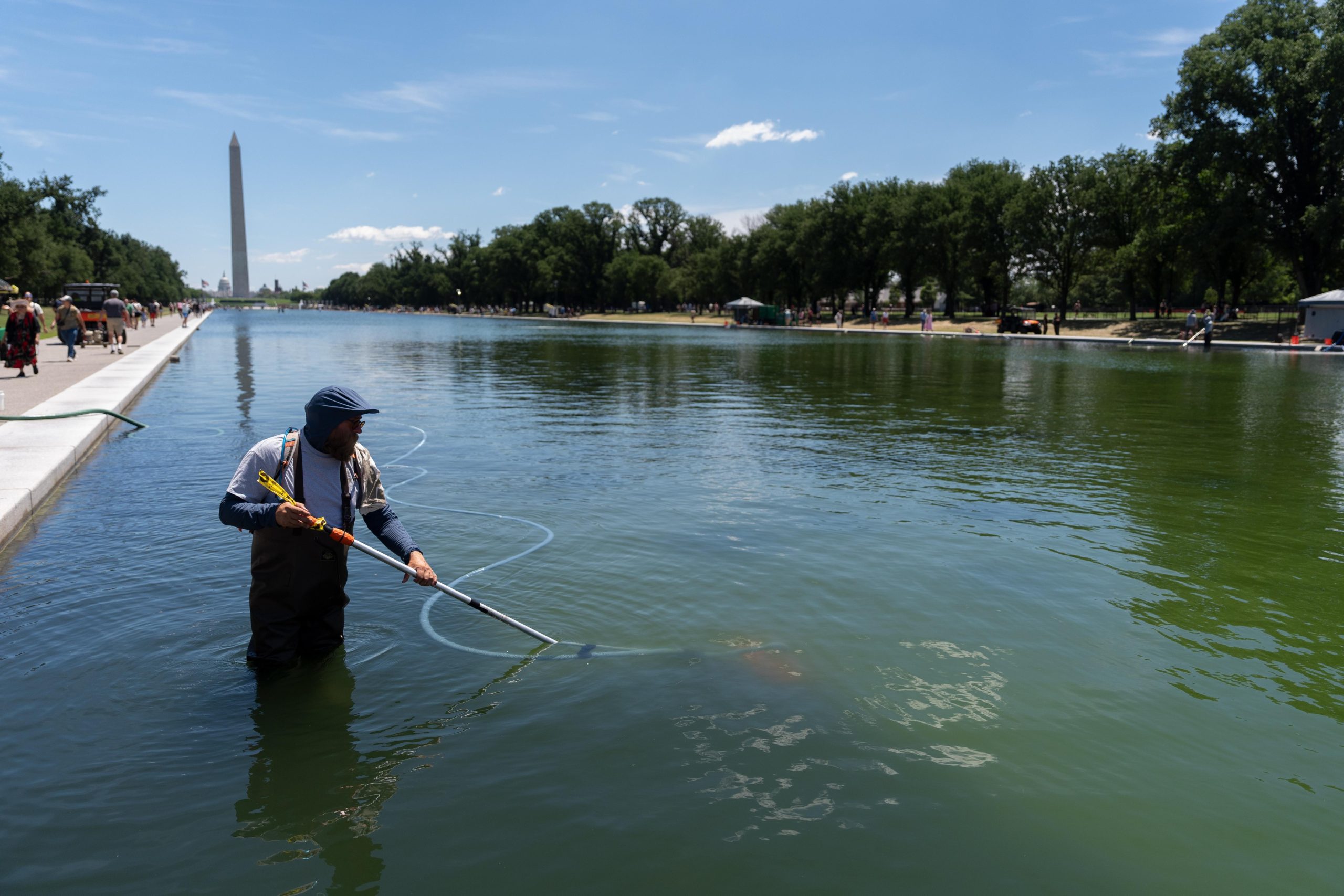
President Trump’s ambitious plan to transform the Lincoln Memorial Reflecting Pool into a vibrant “American Flag blue” ahead of the nation’s 250th anniversary has hit an unexpected and stubborn snag: algae. The multi-million dollar beautification project, intended to enhance Washington D.C.’s iconic landscape, is now battling an unwelcome bloom of pond scum, turning the once-clear waters a murky green and exposing peeling blue liner.
The initiative, part of a broader presidential push to spruce up the capital, saw the 6.5-million gallon pool drained and a new blue coating applied before being refilled. The undertaking came with a substantial price tag exceeding $16 million. However, the intended aesthetic transformation has been overshadowed by a rapid proliferation of algae shortly after the refilling. Federal workers have reportedly resorted to using hydrogen peroxide in an attempt to combat the persistent growth, but the algae bloom continues to thrive.
An Uphill Battle Against Nature
The Lincoln Memorial Reflecting Pool, a prominent feature of the National Mall, has historically faced challenges with water quality. Its sheer size and the presence of natural elements contribute to an environment conducive to algae growth. While the addition of a new liner and subsequent refilling aimed to improve its appearance, it appears to have inadvertently created conditions that favor the proliferation of microscopic aquatic organisms. The peeling of the blue liner further complicates the visual goal, detracting from the intended patriotic hue.
The situation highlights the inherent difficulties in managing large, open-air water bodies. Factors such as sunlight, nutrient levels, and water temperature play crucial roles in the delicate ecosystem of a pool. The recent intervention, while well-intentioned, may have disrupted a natural balance, leading to the current algal outbreak. The ongoing efforts by the National Park Service to manually vacuum the algae underscore the immediate, hands-on approach required to address the problem, even after significant investment.
Beyond Aesthetics: The Broader Context
This incident goes beyond a simple aesthetic disappointment; it touches upon broader themes of environmental management and the complexities of large-scale public works projects. The desire to present a pristine and patriotic image for a significant national milestone is understandable. However, the unforeseen ecological response serves as a reminder that nature often has its own agenda. The substantial financial investment in the project, now facing an uphill battle against natural forces, raises questions about the long-term sustainability of such beautification efforts and the need for more integrated, environmentally conscious approaches.
The “war against algae,” as it’s being framed, is a testament to the ongoing challenge of maintaining iconic landmarks in the face of natural processes. As the nation approaches its 250th birthday, the Lincoln Memorial Reflecting Pool’s current state serves as a visual metaphor for the sometimes unpredictable outcomes of ambitious projects, and the persistent need for vigilance and adaptation in managing our shared public spaces. The question remains whether the project can ultimately achieve its intended visual success, or if the enduring power of nature will continue to dictate its appearance.
Based on materials: Vox



