
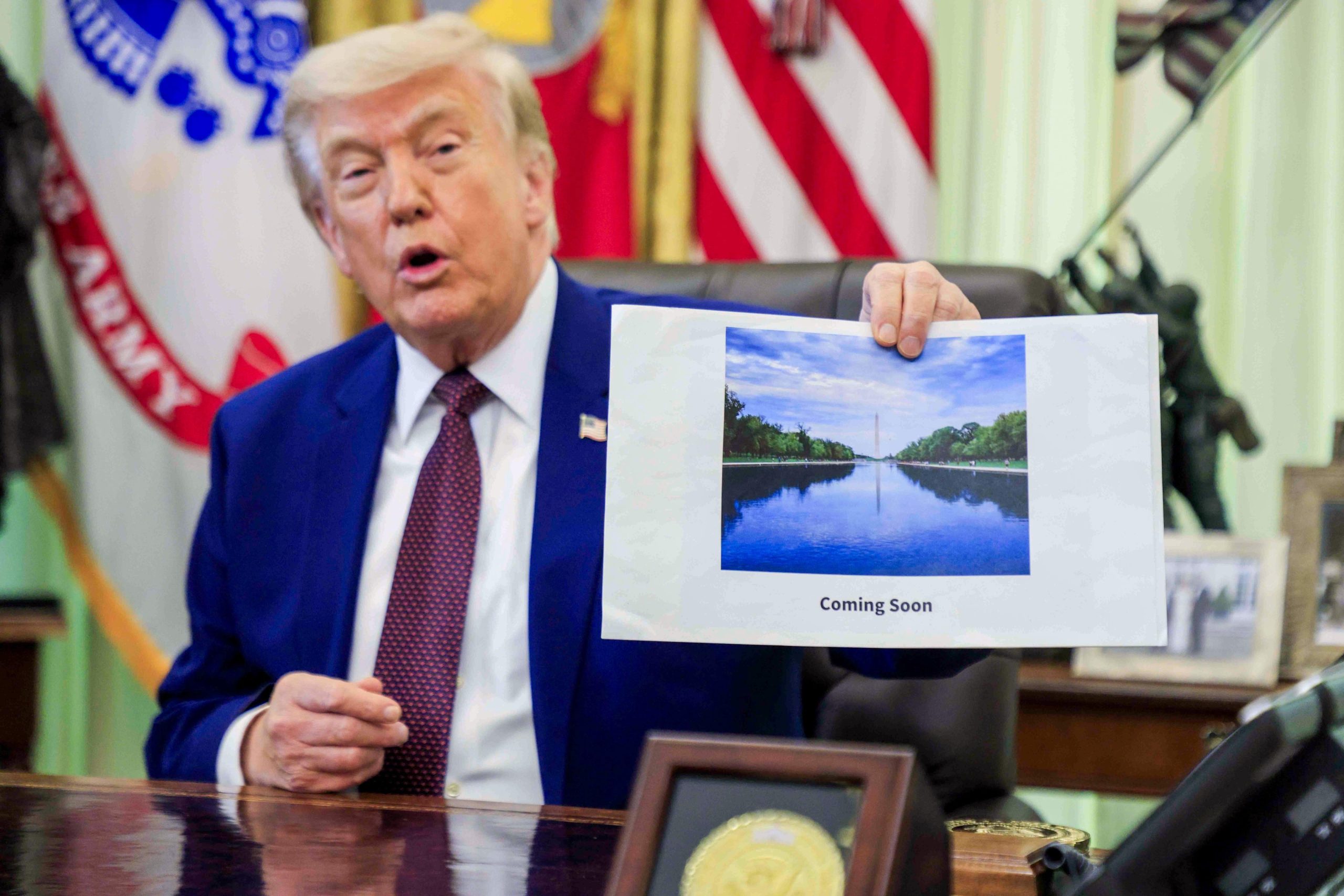
President Donald Trump’s fixation on the Reflecting Pool at the Lincoln Memorial might appear, on the surface, as a peculiar and even comical endeavor. However, a deeper dive into this seemingly trivial project reveals a concerning pattern of behavior, suggesting a potent, albeit shallow, form of authoritarianism at play. The administration’s costly effort to “beautify” the iconic pool, marked by repainting its base and experimenting with chemical treatments for algae, has yielded an ironic outcome: a new algae bloom, potentially a consequence of the very renovations.
Bypassing Procedures for a Personal Touch
What elevates this story beyond a simple public works mishap is the manner in which the project was initiated and managed. President Trump reportedly circumvented standard federal contracting protocols, awarding a no-bid contract for the Reflecting Pool’s renovation to an individual with whom he had a personal connection. This acquaintance had previously pleaded guilty to charges related to conspiracy to bribe a politician, raising significant questions about the integrity of the contracting process and the potential for cronyism. When the project inevitably encountered issues, such as the recurring algae problem, the president’s response was characteristic: swift accusations of sabotage, levied without concrete evidence. This pattern of attributing failures to external, often unnamed, forces is a familiar tactic, designed to deflect accountability and reinforce a narrative of victimhood or external obstruction.
The Symbolism of Control
The Reflecting Pool, a site steeped in historical significance and often associated with moments of national reflection and protest, becomes in this context a potent symbol of Trump’s approach to governance. The obsession with its appearance, coupled with the disregard for established procedures and the quickness to assign blame, speaks to a desire for control and a superficial understanding of complex issues. Instead of focusing on substantive policy challenges or engaging with established institutional processes, the administration appears to be prioritizing visible, albeit ultimately inconsequential, projects that can be personally overseen and claimed as successes. This “shallow authoritarianism” manifests as a drive to exert personal authority over even the most minor aspects of national symbols, while simultaneously fostering an environment where due diligence and transparency are secondary to personal loyalty and perceived immediate results.
A Reflection of Governance
Ultimately, President Trump’s focus on the Reflecting Pool serves as a microcosm of his broader political style. The project highlights a preference for spectacle over substance, a willingness to bend or break rules for personal connections, and a tendency to create external enemies when faced with inevitable challenges. While the algae in the Reflecting Pool may eventually be cleared, the underlying issues of governance, accountability, and the erosion of established norms remain a far more persistent and troubling bloom on the landscape of American politics. The narrative surrounding the pool’s renovation is not just about water quality; it’s a reflection of a leadership philosophy that prioritizes personal vanity and control over the robust functioning of democratic institutions.
Based on materials: Vox



